Pages

Saturday, February 22, 2014

I/D# 1 Unit: N Concept: How do SRT and UC relate?

Inquiry Activity Summary


http://31.media.tumblr.com/tumblr_kueutly2bF1qa3sx1o1_500.gif


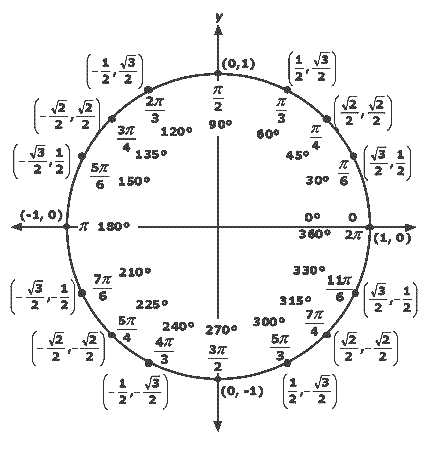
1.First off, i was given a 30' triangle and asked to follow certain steps. First, I  had to label according to the rules of special right triangles. I had a 30' acute angle  which then a 60' and 90' came to add up to 180'. The hypotenuse was 2x, and then the 30' side was xrad3 and the y side was x. The next step told us to simplify all sides so that the hypotenuse was equal to 1. You divide every side by 2x and you get 1,rad3/2, and 1/2. The next steps told us to label the hypotenuse r, the horizontal side x and the vertical side y. I then drew a coordinate plane so that the triangle laid in the first quadrant of the unit circle. I had to label the vertices of the triangle as ordered pairs. They were (0,0), (rad3/2,0), and (rad3/2 ,1/2).


2. Next, we moved on to the 45' 45' 90' triangle which is isosceles. We had to label again according to the rules of special right triangles. We had to simplify all sides so that r was 1. In this case the hypotenuse was xrad2 so we had to divide by xrad2. The x side was x so we divided by xrad 2 and got rad2/2 after we rationalized it. and the y side x also so we got rad2/2 after being rationalized. After we labeled the hypotenuse r and the horizontal side x and vertical side y. Then we drew a coordinate plane so that this triangle was in the first quadrant of the unit circle. Finally we labeled all three vertices of each triangle as ordered pair. They were (0,0), (rad2/2 , 0) , and (rad2/2, rad2/2).


3. Finally, we had to label a 60' triangle. We identified it with the rules of special right triangle. The other side is 30 and we have a 90 degree right triangle. Next we had to simplify the sides so that the hypotenuse was 1. The hypotenuse was 2x to begin with so in order to simplify it to 1 we had to divide by 2x. The horizontal side was x so when I divided it by 2x i got 1/2. The vertical side was xrad3 so dividing it by 2x left me with rad3/2.I then labeled the hypotenuse r and the horizontal side x and vertical side y. I drew a coordinate plane so that the triangle was in quadrant one of the unit circle. Finally i labeled all three vertices of the triangle as ordered pair. They were (0,0) , (1/2, 0) , (1/2 , rad3/2).


4.This activity helped me derive the unit circle because these three triangles lie in the first quadrant of the unit circle. I had known about the unit circle and the values ( rad3/2 , 1/2) (rad2/2 , rad2/2), and (1/2, rad3/2) were taught to me and i was given no reason for why or how they came about. I was simply told to memorize these values. This activity explained to me and showed me where these values came from. Step two was the part that did the most explaining because simplifying the values showed me where the r , x and y, values came from. Step 6 illustrated to me where these values and triangles fit in the unit circle. Knowing how these values are brought about and how they fit into the first quadrant of the unit circle helped me find reference angles and other values on the other quadrants of the unit circle. Knowing the first quadrant helped me fill out the rest of the unit circle without much work. Simply memorizing and knowing the first quadrant allowed me to fill out and understand the following concepts of this unit as well as future and past concepts. This activity was more like the glue of this unit, it brought everything together.


5.The triangles in this activity lie in quadrant one. Since all the signs are positive because it lies in the first quadrants, all the ordered pairs are positive as well. Remember that All Students Take Calculus!!! As we move into the second quadrant, the only the values that are positive are sine and cosecant values, so all the X values of each ordered pair is negative.  The 30 reference angle is 150. The 60 reference angle is 120. The 45 degree reference angle is 135.As we move into the third quadrant, the only values that are positive are tangent and cotangent so both values of each ordered pair are negative.  The 60 reference angle is 240. The 45 reference angle is 225. The 30 reference angle is 210.The last quadrant the only values that are positive are cosine and secant so the Y of each ordered pair is negative. The 30 reference angle is 330. The 45 reference angle is 315. The 60 reference angle is 300. Their ordered pairs stay the same however the signs of certain values change as we move around the unit circle. As the 60 degree traingle moves around the unit circel you can see the location of the 1 and rad3/2 and 1/2 change as it moves around. The angles also get bigger. The same can be said for the 45 degree trainlge and the 30 degree traingle their r,x, and y values all change locations as it moves around but you can see they are used ass the refernce angles for all around the angle. Knowing these angles helps label them all around. In essance the whole unit circel is 4 30 degree trainlges, 4 60 degree traingles, and 4 30 degree traingles but just flipped around as it goes around.


60 degree traingle
https://blogger.googleusercontent.com/img/proxy/AVvXsEg3l4inVZ2EA6LAuMtER4DPqHRdCxYPCuA2wEoM3f185eKvMawkwg-1V9V7-XVTUIUHua2i5Fw5U0jppuCmhm8TYrFkXILc1SZDaDWFQ_NLtNgVyQ0vaQxf1viwRrvJcjGnqLHrbzEcpiZMkpf7XPbu9SpeUZaWW80VeagxihtbpZfTPfJE3iwUu_-reG2D4dS7CIObgBkotEoL=
=blogger&gadget=a&rewriteMime=image%2F*


60 degree traingles
https://blogger.googleusercontent.com/img/proxy/AVvXsEj6I1JOq4IgpoPFhz57-9nyXOU65aUiAgxvEdSwkP_vDWBUksFc0hs9-wb7lyz53gjovCKxdXRP-boO9FWREf9_AGe041kW2cRSfHYZW8EXyMB9FJ6uKM-kwp93ygFP59HGmYKeC8yFj3DPgpORWxUxsccjqAmK5vfgbhVE0HIrkQy1UXN-dCqK4KNyvhLztTGcbCsvZBWQETGJ=
&gadget=a&rewriteMime=image%2F*


30 degree traingles
http://01.edu-cdn.com/files/static/learningexpressllc/9781576855966/The_Unit_Circle_34.gif


45 degree traingle
http://01.edu-cdn.com/files/static/learningexpressllc/9781576855966/The_Unit_Circle_45.gif


45 degree traingles
http://02.edu-cdn.com/files/static/learningexpressllc/9781576855966/The_Unit_Circle_46.gif


THE COOLEST THING I LEARNED FROM THE ACTIVITY WAS that the unit circle actually derived from something.Last year we were just told what the values were , given them, and told to memorize the unit circle under 5 minutes without further explanation as to why we needed to know it or what it helped us in math.
THIS ACTIVITY WILL HELP ME IN THIS UNIT because once I know the first quadrant and the angles and what comes with them, then the units and points, etc, will come easily. For example, knowing reference angles and co-terminal angles help with future and past concepts. 
SOMETHING I NEVER REALIZED ABOUT SPECIAL RIGHT TRIANGLES AND THE UNIT CIRCLE is that everything I have done with the triangles in the my high school years has finally all come together and made sans. All I learned was for a reason and simply not to memorize useless material.Once I knew the unit circle, the rest of the unit circle came easy. A ll i needed to know was in the first quadrant and then this and future concepts correlated with this.


YAY FOR MRS. KIRCH AND HER EXPLANATIONS OF THE UNIT CIRCLE!!!!:)


Sources:

http://31.media.tumblr.com/tumblr_kueutly2bF1qa3sx1o1_500.gif
http://02.edu-cdn.com/files/static/learningexpressllc/9781576855966/The_Unit_Circle_46.gif
http://01.edu-cdn.com/files/static/learningexpressllc/9781576855966/The_Unit_Circle_45.gif
http://01.edu-cdn.com/files/static/learningexpressllc/9781576855966/The_Unit_Circle_34.gif
https://blogger.googleusercontent.com/img/proxy/AVvXsEj6I1JOq4IgpoPFhz57-9nyXOU65aUiAgxvEdSwkP_vDWBUksFc0hs9-wb7lyz53gjovCKxdXRP-boO9FWREf9_AGe041kW2cRSfHYZW8EXyMB9FJ6uKM-kwp93ygFP59HGmYKeC8yFj3DPgpORWxUxsccjqAmK5vfgbhVE0HIrkQy1UXN-dCqK4KNyvhLztTGcbCsvZBWQETGJ=
&gadget=a&rewriteMime=image%2F*
https://blogger.googleusercontent.com/img/proxy/AVvXsEg3l4inVZ2EA6LAuMtER4DPqHRdCxYPCuA2wEoM3f185eKvMawkwg-1V9V7-XVTUIUHua2i5Fw5U0jppuCmhm8TYrFkXILc1SZDaDWFQ_NLtNgVyQ0vaQxf1viwRrvJcjGnqLHrbzEcpiZMkpf7XPbu9SpeUZaWW80VeagxihtbpZfTPfJE3iwUu_-reG2D4dS7CIObgBkotEoL=
=blogger&gadget=a&rewriteMime=image%2F*

Monday, February 10, 2014

RWA: #1 Unit M Concepts 4-6


Ellipse


  1. Mathmatical Definiton : "Set of all points such that the sum of the distance from two points is a constant." (Kirch)
  2.  Algebraically defined: An ellipse can either be "fat" or "skinny". The eqaution for a fat graph is  (x-h)^2/a^2 +  (y-k)^2/b^2 =1, the bigger number "a" being on the bottom of x. If the graph is skinny then the eqaution of the graph is (x-h)^2/b^2 +  (y-k)^2/a^2 =1, the bigger number  "a" being below the y in this instance. In the eqaution, the If the bigger number is under the x thwn the graph is going to be fat and if the bigger number is under the y then the graph is going to be skinny. The center is (h,k). H always goes with x and K always goes with y.( Kirch) A skinny graph is going to have a vertical major axis, the axis which the foci lie on, therefore it will be x= #. A fat graph's major axis is going to have a horizontal major axis so it will be y=#. To find the veticies, co-vertices, and foci, you must first know what a,b, and c stand for. A be be derived from the standard eqaution. A being the biggest number and then the sqaure root being taken from it . B then being the second number . To find c , you must use the eqaution a^2-b^2=c^2 following the rule that a >b.(kirch) 

https://images-blogger-opensocial.googleusercontent.com/gadgets/proxy?url=http%253A%252F%252Fformula.algebra.com%252Fcgi-bin%252Fplot-formula.mpl%253Fexpression%253D%252528x-h%252529%25255E2%25252Fb%25255E2%252
B%252B%2B%2528y-k%2529%255E2%252Fa%255E2%2B%3D%2B1%26x%3D0003&container=
blogger&gadget=a&rewriteMime=image%2F 
    http://formula.algebra.com/cgi-bin/plot-formula.mpl?expression=%28x-h%29%5E2%2Fa%5E2+%2B+%28y-
    k%29%5E2%2Fb%5E2+=+1&x=0003


    Eccentricty is a measure  of how much the conic section deviates from being circular.(e=c/a) The ecccentricty of an ellipse must fall in the range of 0<e<1. To find the verticies, you must know the major axis. If the major axis is y=# then the term in the verticie that WILL NOT change will be the y term. However if the major axis is x=# then the term that will not change is the x term. To find the number that changes you must use the center . For example if the number is 5 and the term either a or b is 3 then you go up and down by 3 to get the number.  
      The eccentricity of the graph determines how far away the ellipse deviates from being a circle. "An ellipse is defined in part by the location of the foci. However if you have an ellipse with known major and minor axis lengths, you can find the location of the foci using the formula below. The major and minor axis lengths are the width and height of the ellipse."(http://www.mathopenref.com/ellipsefoci.html) The foci will determine how far the ellipse deviates from being a circle since the eccentricty reqauires the use of "c",foci, divided by a.
    3. REAL WORLD APPLICATIONS
https://images-blogger-opensocial.googleusercontent.com/gadgets/proxy?url=http%253A%252F%252Fupload.wikimedia.org%252Fwikipedia%252Fcommons%252
Fthumb%2F6%2F65%2FEllipse_Properties_of_Directrix_and_String_Construction.svg%2F411px-Ellipse_Properties_of_Directrix_and_String_Construction.svg.png&container=blogger&gadget=a&rewriteMime=image%2F*
The image displays how the distance from one point to another along the focus is the same all around ,such that it is a constant. It also displays the features of the graph and how it looks like. The foci on the major axis, the minor axis, and how to find the eccentricity.

  Math is indeed fun! The website explains ellipses and provides information about the conic section.
EXTREMELY AMAZING WEBSITE ------>http://www.mathsisfun.com/geometry/ellipse.html

  The video shows everything you would ever want to know about graphing ellipses and all the essential parts.
VIDEO HERE !!! ---------->http://www.youtube.com/watch?v=lvAYFUIEpFI

https://blogger.googleusercontent.com/img/proxy/AVvXsEh5h8peeuMDBHH8DVRZlR64Ik1UAuW61TCpu_yXnwzomn7rIPFgf-paPJe4B_k2CWt9YcFBn0wvP5hNLDrknjrGfuspZh889Ch3LzXBI8iQUT3p5tf_uPzSHUTSG2HZ1-JIHYP2UPzmLSBxpCsCx6-2rJU0hwNSIeRkdY98my0=
.png&container=blogger&gadget=a&rewriteMime=image%2F*
https://blogger.googleusercontent.com/img/proxy/AVvXsEhdFhpdGa65fdHHr0mTtDxzgNlURzeKWspsUScSARuOjWZ3o8RUHQX_paLd3-UZp0xKmhv64D66wVSV51oWdCDJ_XD6jjZdq-23xcgG74hdekqbSKDpq2rSm_ekHXZPi11bvlTUwLlDPzifO-0D8QRXWULYZSU=
This image basically just shows the features of the graph and how two lines from the focus are the same all around. It provides the eqaution to find the graph and "c". 
In the image it illustrates a real life example of a conic section. The distance around the conic from the foci is the same all around. In real life, the ellipse the most occuring "curve" seen beacuse the circle seen from an angle, is an ellipse(http://britton.disted.camosun.bc.ca/jbconics.htm) The reason why ellipses are the most common conic seen is because a circle veiwed a certain way is a ellipse. For example a tilted glass of water is an ellipse.Any cylinder sliced at an angle is also an ellipse. Each planet moves around the sun in an elliptical movement.


4. SITATIONS  http://upload.wikimedia.org/wikipedia/commons/thumb/6/65/Ellipse_Properties_of_Directrix_and_String_Construction.svg/411px-Ellipse_Properties_of_Directrix_and_String_Construction.svg.png

http://www.physics.unlv.edu/~jeffery/astro/ellipse/ellipse_001.png

http://www.youtube.com/watch?v=lvAYFUIEpFI

http://www.mathsisfun.com/geometry/ellipse.html

http://britton.disted.camosun.bc.ca/elliplanet_lg.JPG

http://www.mathopenref.com/ellipsefoci.html

http://en.wikipedia.org/wiki/Eccentricity_(mathematics)

http://britton.disted.camosun.bc.ca/jbconics.htm

http://formula.algebra.com/cgi-bin/plot-formula.mpl?expression=%28x-h%29%5E2%2Fa%5E2+%2B+%28y-k%29%5E2%2Fb%5E2+=+1&x=0003 

Tuesday, December 10, 2013

Fibonacci Beauty Ratio Reflective Essay (Extra Credit)

415


Golden ratio in human body

In the first video they introduce a man by the name of fibonacci and his numbers. His numbers are divided and numbers close in proximity are produced. The golden ratio is a number, 1.6180339887. Artist , scientists, and sculptors use this number ratio to build their mater pieces. The number was used by many famous painters to make their work "beautiful".


Fibonacci and the golden mean

In 1201 Fibonacci studied mathematics but first introduced Christian religion to the world. He wanted to observe the number of bunny rabbits that were born each year. In conducting this expedient he found that the numbers held a significant pattern. Each number in the series was equivalent to the two previous numbers sum in the sequence. This was the beginning of the unlocking of many other things. It helped in the field of botany. It also helped with the architecture of buildings.


Nature by numbers

In this video no words are being said. However, images are being broken down on the screen. They are shown in detail and complexity . They are being zoomed in and shown the little details and how mathematical figures are used to make these animals and things in nature and society. It also shows how the littlest details create the most beautiful masterpieces. Math ratios and numbers are shown when the images are broken down.


The beauty of golden ratio

In this website, in ancient architecture the beauty ratio was used. The great pyramids of Giza was used on the basis of the golden ratio. The parathion  has its exterior based on the golden ratio. The width and height of the U.N. building is also based upon this number ratio.


Golden ratio in art and architecture

The famous swiss french architect and painter Le Corbusier  was a strong advocate of the golden ration. However, in the beginning, he strongly disliked and had negative connotations about  the use and work of this number. He later used it to help inspire his work. He has a basic interest in forms and structures.


Summary
While watching these videos and reading the articles I found every bit of information interesting. My favorite video to watch was the nature by number one. Seeing how the simplest of details was created from math was astounding. Overall the information that arises from fibonacci and his number was very intriguing and I actually found his golden ration was mathematical beauty to be offensive. Beauty is from within not outside appearance,.

Sunday, December 8, 2013

SP:#6 Unit K Concept 10: writing a repeating decimal as a rational number using geometric series

 
Unit K Concept 10: writing a repeating decimal as a rational number using geometric series


When doing these problems remember to not worry about the number in front of the decimal right away: forget about it in the beginning. Since it is a 3 digit repeating decimal it goes on top of 1000 making r=1/1000. You solve it and plug it into the formula and one you get your answer you add it to the umber in front which you previously ignored in the beginning.

Sunday, December 1, 2013

Fibonacci Beauty Ratio Blog Post (Extra Credit)


Fibonacci Beauty Ratio Blog Post (Extra Credit)


The Fibonacci number is 1.618.... and of my group members Viviane was the closet to that number. What we did was measure our "mathematical" beauty with measurements of various body parts.
In essence I don't think its really beauty physically that we measured but the lengths were beautiful numbers. I would say it isn't that valid because various people had numbers close to this but they are all different shapes and sizes , in all beauty isn't just solemnly one thing, in this case the numbers, however this activity proved to be fun and exciting.